Ignition & Flame Rods
Spark igniters and flame ionization rods controlling combustion safety.
Gas Tankless Services
Gas tankless water heaters deliver high-GPM hot water flow using powerful natural gas or liquid propane burners, variable-speed blowers, and electronic gas controls.
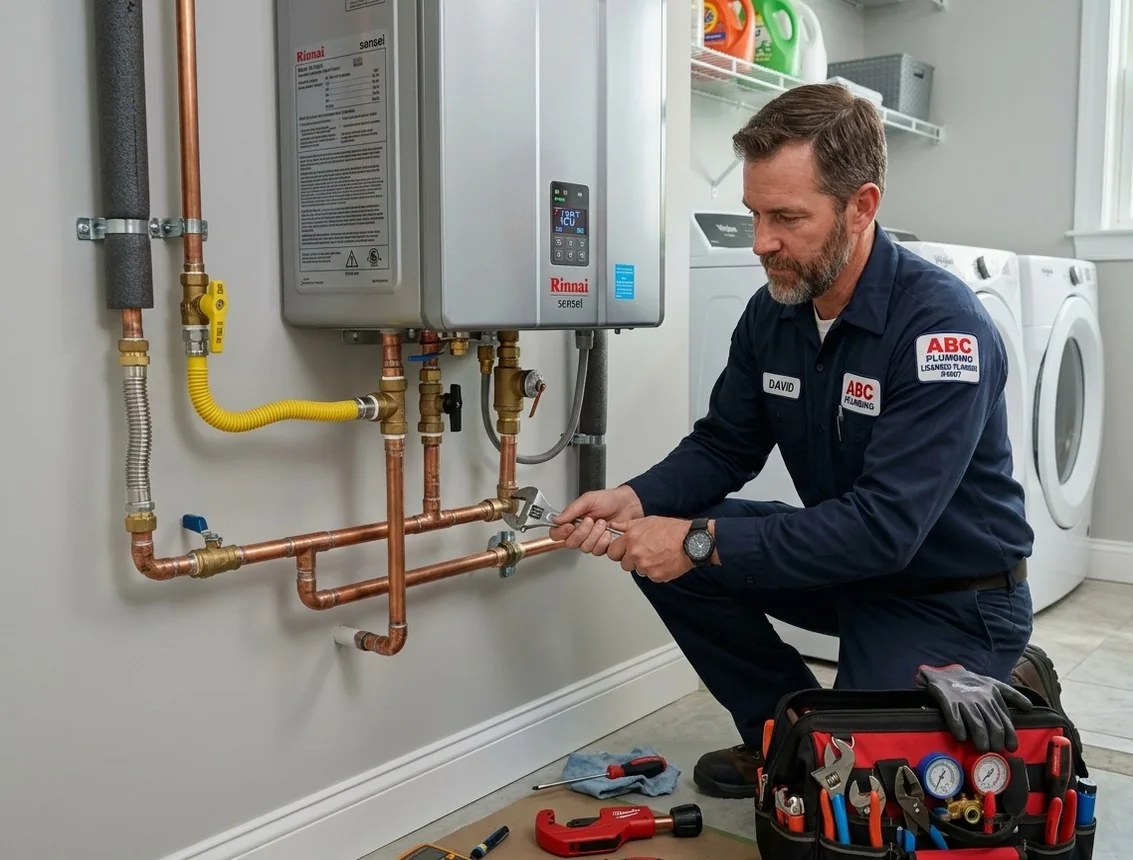
When a hot water faucet opens, water flow triggers a flow turbine sensor. The control board starts the combustion fan, opens electronic gas valves, and fires spark igniters to light multi-stage gas burners. Heat transfers through copper/stainless steel exchangers to heat water instantly.
Gas tankless water heaters are popular for whole-home application due to their high heating capacity (up to 199,000 BTUs). They are available in non-condensing (standard efficiency) and condensing (ultra-high 95%+ efficiency) configurations.
Service and repair require specialized expertise in gas line pressure testing, burner combustion modulation, electrical spark ignition systems, and direct exhaust venting safety.
Spark igniters and flame ionization rods controlling combustion safety.
Electronic proportional gas valves regulating fuel flow to match water GPM.
Variable-speed blower supplying fresh air and pushing exhaust flue gases.
Plastic drain trap collecting acidic water vapor in condensing gas units.
Condensing models extract latent heat from flue gas for 95%+ efficiency; non-condensing models exhaust hot flue gas directly.
Ensuring correct fuel line size (typically ¾") and inlet gas pressure (5" to 10.5" WC).
Sealed double-pipe or concentric venting drawing fresh air and expelling exhaust gas safely.
Staged burner segments firing dynamically to save fuel during low-flow usage.
Verify static/dynamic gas pressure and check intake air vents for blockages.
Inspect igniter spark arc, clean flame sensor rod, and verify solenoid valve coil resistance.
Flush mineral scale from copper/stainless tubes and clear combustion fan blades.
Test high-fire/low-fire manifold gas pressure and measure exhaust flue gas safety.
Tankless systems from major manufacturers can differ in components, diagnostics, maintenance procedures, and error-code definitions. Service resources cover major brands found in service areas across the country.
Explore more tankless water heater services from TanklessFixer across specialized system categories.
Explore resources, causes, and options for tankless water heater ignition & flame sensor repair.
Learn More →Explore resources, causes, and options for tankless water heater gas valve & burner repair.
Learn More →Explore resources, causes, and options for tankless water heater venting repair.
Learn More →Explore resources, causes, and options for tankless water heater descaling & flushing.
Learn More →Condensing heaters contain a secondary stainless steel heat exchanger to extract heat from flue gases (95%+ efficiency), while non-condensing heaters exhaust hot gases directly (82% efficiency).
Gas tankless units demand up to 199,000 BTUs instantly when fixtures open, requiring adequate gas line diameter to prevent pressure drops.
Yes, most manufacturers offer gas conversion kits containing specific burner orifices and gas valve recalibration instructions.
If the blower fan runs but the burner fails to ignite, the unit may have an ignition failure, closed gas valve, or dirty flame sensor.
Gas tankless units should be serviced annually, including descaling, cleaning the flame sensor, checking gas pressure, and inspecting venting.
TanklessFixer organizes tankless water heater services by state and city so homeowners can quickly find local repair, maintenance, installation, and replacement information. Search or select a state below to find local city coverage.
Connect with local service resources for repair, troubleshooting, maintenance, installation, and replacement across state and city service areas.
Call (833) 643-1120