Thermistor Resistance Drift
Internal electrical resistance changes over time, sending inaccurate temperature data to circuit boards.
Temperature & Flow Sensors
Precision temperature sensors (thermistors) and turbine flow sensors provide real-time data to control modules to maintain stable water temperatures.
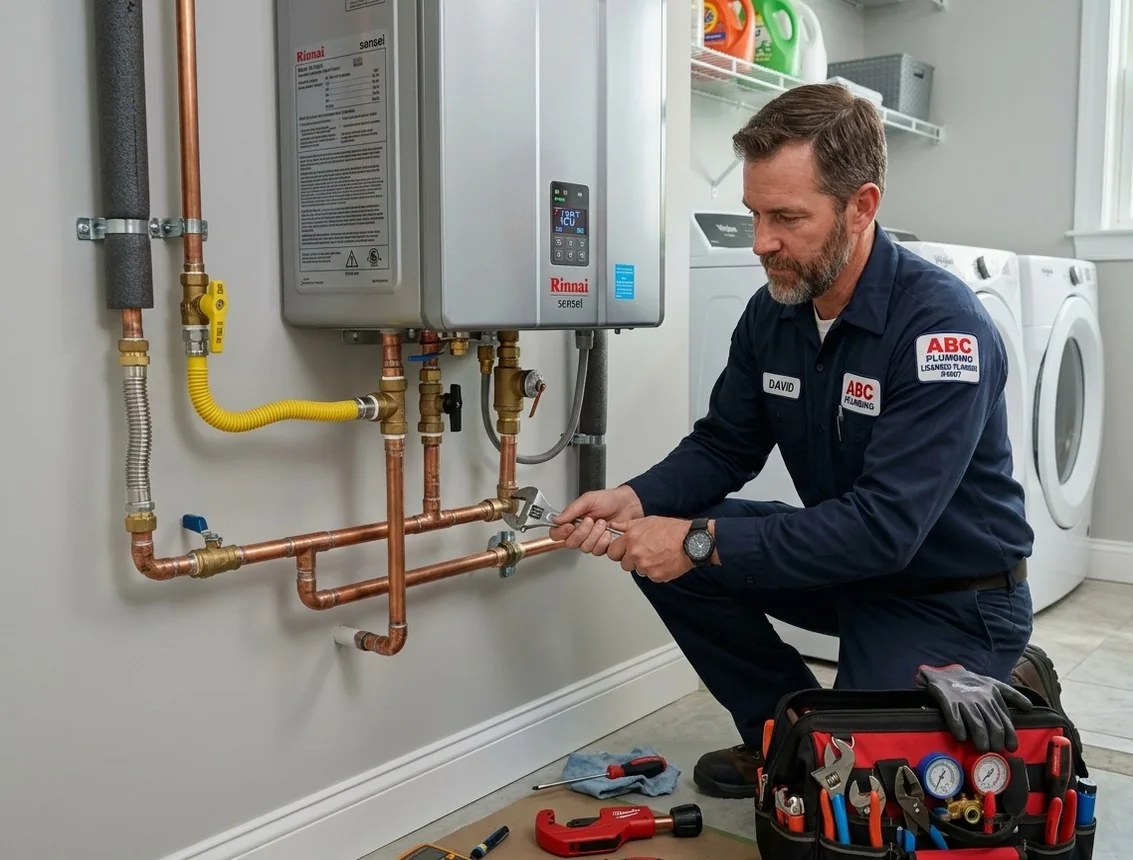
Tankless water heaters do not use mechanical tank thermostats. Instead, they use electronic thermistors to measure incoming cold water and outgoing hot water temperatures, along with turbine flow sensors to measure water volume. The control board uses this data to modulate gas valves or heating elements instantly.
Continuous temperature control requires rapid feedback. Incoming water thermistors read incoming supply temperature, while outgoing thermistors measure water leaving the heat exchanger.
If a thermistor gets coated with scale or experiences electrical resistance drift, the control board miscalculates required heat input. This leads to temperature fluctuations, known as a 'cold water sandwich,' or error code lockouts.
Internal electrical resistance changes over time, sending inaccurate temperature data to circuit boards.
Mineral crust coating thermistor wells slows down temperature response times.
Debris or scale jamming the magnetic flow rotor prevents flow activation signals.
Bimetallic safety limit switches opening due to localized heat exchanger overheating.
Measures cold supply temperature so the control board calculates exact required BTU heating energy.
Monitors final output temperature, signaling modulating valves to fine-tune water temperature.
Measures water flow volume in gallons per minute (GPM) to trigger ignition and modulate heat.
Safety switch that cuts power to gas valves or heating elements if temperatures exceed 180°F.
Disconnect electrical power and remove cabinet cover to reach sensor wiring harnesses.
Use a multimeter to measure thermistor resistance in ohms and compare against temperature-resistance charts.
Remove thermistors and clean scale crust from sensing probes and flow turbines.
Install new factory thermistors or flow sensors, restore power, and verify stable water temperature.
Tankless systems from major manufacturers can differ in components, diagnostics, maintenance procedures, and error-code definitions. Service resources cover major brands found in service areas across the country.
Explore more tankless water heater services from TanklessFixer across specialized system categories.
Explore resources, causes, and options for tankless water heater no hot water.
Learn More →Explore resources, causes, and options for tankless water heater control board & wiring repair.
Learn More →Explore resources, causes, and options for electric tankless water heater heating element repair.
Learn More →Explore resources, causes, and options for tankless water heater recirculation pump repair.
Learn More →A cold water sandwich occurs when residual hot water in pipes is followed by a burst of unheated water while the unit purges and re-ignites. Slow-responding thermistors or flow sensors exacerbate this issue.
Disconnect the thermistor wire harness and measure resistance across terminals with a multimeter. Compare the reading in k-ohms against the manufacturer's temperature table.
Yes, if sediment or scale jams the magnetic turbine inside the flow sensor, it cannot detect water movement and will not signal the unit to fire.
Error codes 32 or E3 usually mean the outgoing water temperature sensor is shorted, open-circuited, or reading out of acceptable safety ranges.
Thermistors are located on the cold water inlet pipe, the heat exchanger copper outlet, and near the hot water outlet pipe inside the cabinet.
TanklessFixer organizes tankless water heater services by state and city so homeowners can quickly find local repair, maintenance, installation, and replacement information. Search or select a state below to find local city coverage.
Connect with local service resources for repair, troubleshooting, maintenance, installation, and replacement across state and city service areas.
Call (833) 643-1120